
“The only alternative to getting older is—you guessed it, so stop watching from the sidelines and get in the game.”
 Let’s face it—the only viable alternative to getting older is not one most of us are interested in. Yes, there’s that icy cryogenic thing,
  but other than megalomaniac nutjobs in the movies, who really wants to get stashed in a freezer with the baby peas and cauliflower? So you can be thawed fifty or a few thousand years later like a flash frozen ice age T-Rex and try to pick up where you left off before you decided to try life as a Popsicle? Not me. And I suspect not you.
So, what are you gonna do when getting older is the only game there is?
You are going to play as though your life depended on winning—because it does.
I’m about to dabble in a sports metaphor and those who know me well will fall out  laughing, swear that I know as much about sports as I do about quantum
  mechanics and wait for me to make a fool of myself. But I think the comparison is apt, so I shall plunge ahead, risking ridicule and derision and hope I do know enough about sports to fake my way through this.
Most athletic games are divided into periods—quarters, innings, sets or the like, which only theoretically correspond to actual time telling devices used by regular people because in sporting matches, they have  the miraculous ability to stop time. In real life however, we have no such power and must let the clock run—minutes, hours, days, years flying by—whoosh! Never to be seen again. We have no pause, instant replay or measures of time that hang in the air endlessly awaiting our decision to restart the clock.
The game of life stays in progress and whether you are ready or no t, we have to keep on keepin’ on. In addition to the magical “stop action” that occurs in sporting contests, many games also grant the competitors the privilege of a half time. A break right in the middle of the game! It doesn’t matter who’s winning or who’s losing—
everyone gets an intermission. Yep. Just like that, the gift of a time out is yours without even asking for it! So no matter how the game is going half time offers an opportunity to regroup, change strategy, evaluate, assess strengths and weakness—yours and your opponent’s. Back in the locker room the coach uses pep talks, threats, prayers, shame, rants, praise–whatever is necessary for the team to either maintain the lead, or snatch victory from the wide open, hungry jaws of defeat. Half time is the chance for the game to begin anew. Wouldn’t it be wonderful if life could be the same way?
It can.
That’s what this time of your life is.
 Although becoming a centenarian is more and more common these days, I accept that I’m pushing it when I say 50 is the half way mark in the game of life —but since our forties and fifties have long been considered “middle age”, there is plenty of precedent for this argument. So humor me, OK?
I used my late 40’s to assess what I liked and didn’t like about my life, to examine where I was, where I wanted to be, who and what I wanted to keep in my life, what needed to go and most importantly to decide how I wanted to approach living the next half of my life. At 50, I took myself a half-time and so should you.
We don’t have an undo button in life. What we’ve already done, the part of life we have lived already is past. But we certainly can make completely new kinds of choices going forward—you still have the have the rest of your life—however long that is.
You’re in the game.
It’s half-time.
You need a break.
Take one while you can.

HOMEWORK ASSIGNMENT
1) Draw a circle—one you will think of as an old fashioned analog clock—you know like the ones we learned to tell time on with the “big hand” and “little hand” before the digital revolution relegated time telling skills to the same “has-been” pile of memories as an abacus and gathering the family around a rotary dial phone to share a “long distance” call. Make your circle big, really big.
2) Then draw a vertical line through the middle as though it were six o’clock. Except I want you to think of six o’clock as 0—where your life began and twelve o’clock as 50.
3) Freely fill in (using any method you choose) the space between zero and fifty (six and twelve)—in other words, fill up the left side of the circle—with what you have done—the significant achievements and happenings that have taken place in your life thus far: school degrees, jobs, marriage, children, moves, even divorce and deaths. It may be pretty crowded or fairly empty—that depends of course on what you have done with the first half of your life.
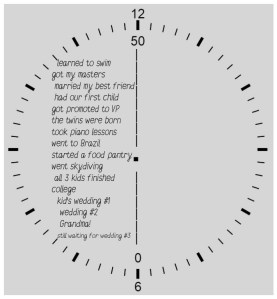
4) Then look at the wonder of the other half of the circle—the part that goes from 50 to zero (twelve to six). What you have is a huge blank space that you can fill in any way you choose. Using the experience you have gained through the grace of aging and consider carefully, thoughtfully, whimsically what you would like to see take the place of the empty space. And remember—you are free to go outside of the lines!

 simply amazed at the transformation, I’m astounded that Susie Schlub, in her sweats or mom jeans, oversize frumpy top (whether she is oversize or not) and sneakers didn’t do something before she was ambushed-or secretly submitted
  as “deserving” (which means they’re tired of her looking like hell) by a well-meaning daughter or friend. I am particularly intrigued by the programs that show Ms. Frump actually looking pretty fly at some point in her past. What happened?
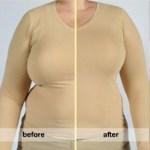 didn’t seem to notice that her boobs were taking a nice nap on her waist before the Makeover Magician showed her what a proper bra could do. Is poor tired, tragic, overworked Susie visually challenged? Does she live in a world without mirrors? How could she not know that her hairstyle, which was probably only marginally fashionable in 1982 is hopelessly outdated in the 21st Century?

 over heels need a visit to the shoemaker or maybe just to be thrown out? Never mind the help available from fashion magazines, catalogs, stores, TV shows and movies. A plain old mirror—purchased at your local discount store and nailed on the inside of a closet door or even leaned against the wall— would have done the trick. Why oh why didn’t she see herself?
 coiffure and magic makeup. And in the reveal, Voila! We have the modern, refreshed, jazzy— Susie Sharp! We’ve all seen these memorable moments and old Suze looks great! Mostly not the Naomi or Giselle unrealistic/unattainable standard we’ve been taught to compare ourselves too, but so much
  better than before that she’s hardly recognizable to herself. Then Susie breaks down and begins to weep—“I didn’t know I could look like this! Oh! Thank you. Thank you….” Now we’re not talking plastic surgery makeovers here—maybe a little teeth whitening – but the rest is the easy stuff.
 another way. CUTE ALWAYS COUNTS. It counted when you were a baby and your Mom dolled you up. It counted at six when you got that new dress to wear for your birthday party or Easter Sunday. It counted when you were fourteen and hoped “he” noticed how cute you looked in your heather blue box pleated mini skirt and matching knee socks. It counted at twenty five when you were trying to
 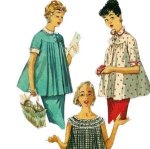 impress them on the job. It counted when you planning to say “I do.” It counted when you put on those awful, (pre-Liz Lange stylish maternity-wear) “hatching jackets” with the dumb, sweet Peter Pan collar and bow meant to conceal your baby bump. And CUTE COUNTS now too, you have just forgotten how much.


 every single day. My dad, who worked in construction and dressed accordingly, had his Sunday and Friday/Saturday “Up the Street” suits, sports jackets and tuxedoes tailor made. As a girl, I remember going to Charlie Baker Clothier with him to look at fabric swatches and pick out buttons—because all of it mattered. Now back to my mom. In her early 80’s she brought quite unexpectedly to a halt by some fairly debilitating health issues. Even after months of being house or hospital bound—she rolled her hair every night and put on her good


 between teenage trashy—oops! I mean teenage trendy, and resignation retirement rags. No you can’t dress like your fifteen year old daughter or the twenty-three year old hostess at your favorite restaurant, but even without belly baring shirts (no navel piercing please) and low rise pants (I also suggest that you pass on the above-the-crack, tramp-stamp tattoo) BELIEVE ME, you can stay hot—or get hot for the first time!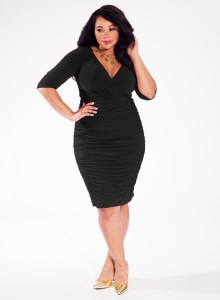




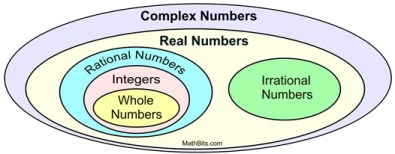 and relaxation–not only told you what was there, they told you how to feel about it. Of course by now, I was no longer even listening to him. I was off on my own tangent because I could already see how his Real, Imaginary, Complex, Prime, Negative, Positive, Rational, Irrational, Sublime NUMBERS fit exactly what I thought about aging.
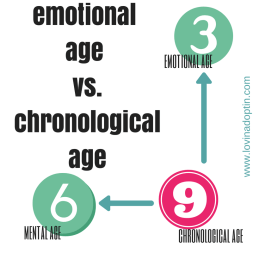 There’s Chronological Age (We know how this one works—count up from birth), Biological Age (Medical tests indicate how well or poorly our bodies are handling the passing of time), then we have Intellectual Age (Are we too old to be this dumb?) Emotional Age and Social Age (Are we mature? Do we play well with others?)
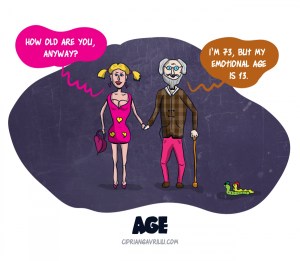 if you feel thirty-five, so be it.
 expensive cut of meat? Enough said.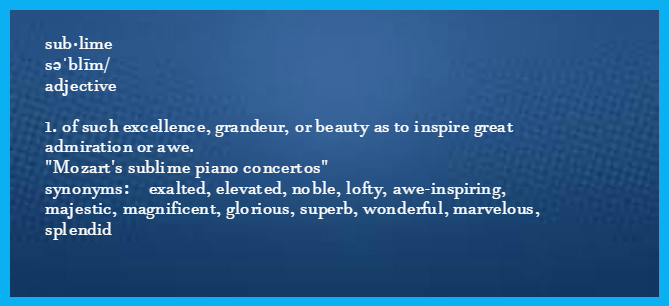


 Like the Harpies of mythology, she is fierce, bad-tempered and relentless. She’s the one who makes you wonder if you’re good enough. By now her nagging little voice has been whispering bits and pieces of self doubt into your psychic ear for decades, so long in fact, that at this juncture it seems like harmless white noise—you aren’t even aware of her presence any more. But she’s anything but harmless and she needs to go. Now.
 first words back when you were a little girl and she was just a little Harpy in Training (H.I.T.). You hadn’t begun to “develop” yet—as they used to say, much less develop any anti-Harpy skills. So she went to work on your young, defenseless, happy little self. “How
  come you don’t have a Barbie book bag?” (Translation: The CUTE girls all have Barbie book bags while you have the practical blue one your mother insisted would last a couple of years.) “Why don’t you have streamers on your bike?” (Translation: But even if you get streamers what if
  they’re not the right color?)
  “Only a B in geography?” (Translation: Not quite as smart as Melissa huh?) “If you could jump higher you would have made the volleyball team.” (Translation: You’re too tall/short/fat/awkward— what ever gave you the idea you could be an athlete?)
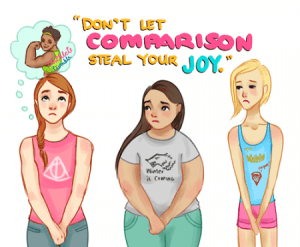 And so the plague begins. Its most telling symptom is unconscious comparison—almost always to other women. We compare ourselves to our friends, sisters, mothers, cousins, co-workers, neighbors, strangers, bosses, movie stars, and sadly even to our daughters. Sometimes we know we’re doing it, but mostly we’re unaware of how many times a day we think of ourselves in terms of how we measure up to someone else, or someone else’s expectations. Those expectations are, more often than not, a presumption on our part—
 because if we don’t think we’re good enough, how can anyone else possibly miss the bright flashing neon marquee on our forehead announcing our long list of shortcomings to all the world? Believe me, despite the fact that it blinds YOU nearly every time you look at yourself, THEY don’t see it until you point it out. Why? Because they’re far too busy worrying if you are scrutinizing their list of personal inadequacies.

 Cute Still Counts